
Hydrogen Production Technology
Natural gas to hydrogen technology
After pre-treatment, natural gas or other light hydrocarbon raw materials are mixed with steam and enter a special conversion furnace. Under the action of nickel catalyst SCST-20X, steam reforming reaction occurs to generate conversion gas containing H2, CO2, CO and other components. After recovering heat from the conversion gas, the conversion gas containing CO2 and H2 is obtained through water vapor shift reaction, and then purified by PSA to obtain high-purity H2. The PSA tail gas is returned to the conversion furnace for combustion and heat recovery.
CH4+H2O→3H2+CO-Q
CH4+H2O→3H2+CO-Q
Physical and Chemical Properties
| Project | Indicator |
| Device scale, Nm³/h | 300–80,000 |
| Hydrogen purity (V) | 99–99.999% |
| Pressure, MPa | 1.5–3.0 |
Process Flow
The process consists of two parts: a natural gas steam reforming system and a pressure swing adsorption (PSA) system. The feedstock natural gas, after compression and desulfurization, is mixed with steam and converted into H2, CO, and CO2-containing reformed gas at 750-850℃ under the action of catalyst SCST-20X. Further, a steam shift reaction yields a reformed gas containing CO2 and H2. Finally, the PSA process produces H2 of the desired purity.
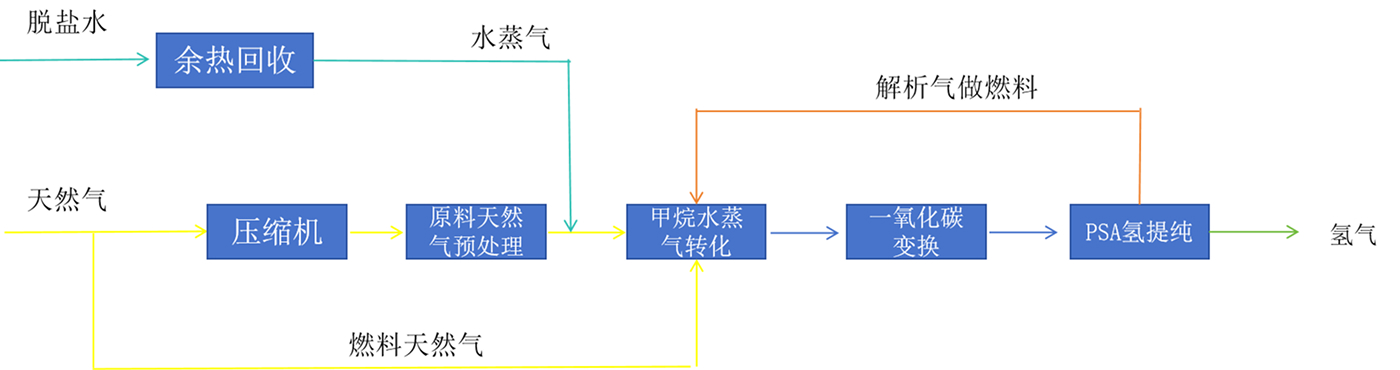

5000-80000 Nm3/h natural gas hydrogen production unit
Explore More About Catalyst

Contact


