
Hydrogen Production Technology
Conventional Methanol-to-Hydrogen Technology
1. Methanol-to-hydrogen technology has certain advantages among various hydrogen production technologies due to its wide availability of raw materials, technological maturity, ease of operation, economic efficiency, and environmental friendliness.
2. Process Flow: Methanol and steam, under specific pressure and temperature conditions, pass through a methanol-steam reforming catalyst bed to generate reformed gas, whose main products are carbon dioxide and hydrogen. This reformed gas is then subjected to pressure swing adsorption to obtain product hydrogen with a purity of 99.0%~99.999%.
Chemical Reaction:
CH₃OH → CO + 2H₂ ΔH = +90.7 KJ/mol
CO + H₂O → H₂ + CO₂ ΔH = -41.2 KJ/mol
Overall Reaction: CH₃OH + H₂O → 3H₂ + CO₂ ΔH = +49.5 KJ/mol
Company's Hydrogen Production Process
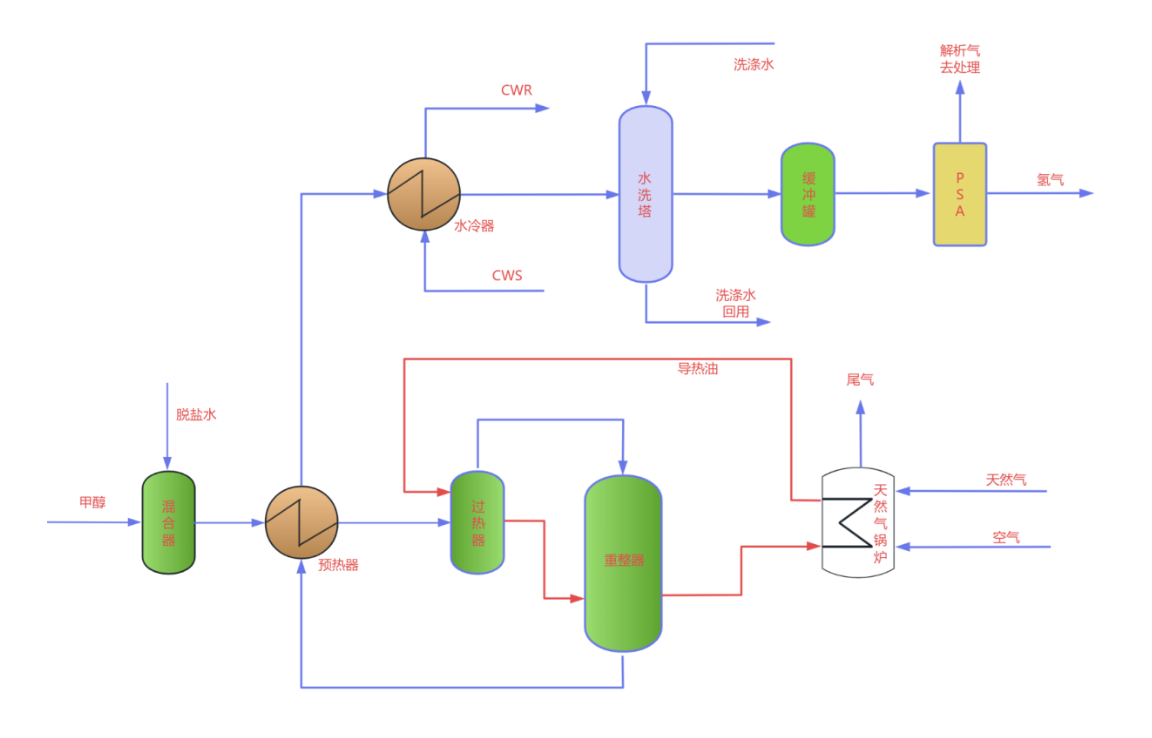
This production process was developed and industrialized by several researchers within our company after years of research. Through years of production practice and improvement, the technology has been perfected. This technology has the following characteristics:
Reduced Energy Consumption: Compared to natural gas-based hydrogen production, the self-pressurization technology reduces energy consumption.
Dedicated Catalyst: SCST-401 features high activity, excellent selectivity, and long lifespan, resulting in energy savings at low temperatures.
Adjustable Hydrogen Purity: It can produce H₂ with a purity of 99.0%–99.999%, meeting the needs of different users.
Superior Adsorbent Performance: Domestically leading, featuring high strength, long lifespan, large adsorption capacity, and high separation efficiency.
Automated Control: The device is microcomputer-controlled, highly automated, easy to operate, and reliable.
Process Technical Specifications
Hydrogen Purity: 99–99.999%
Operating Flexibility: 10–120%
Impurity Content: CO + CO₂ ≤ 10 ppm (or lower), H₂O ≤ 10 ppm
Operating Pressure: 0.8–3.0 MPa (adjustable)
Explore More About Catalyst

Contact


